
Just exercising will not make you stronger. If it did, marathon runners would have the largest and strongest muscles. If you want to make your muscles stronger, you have to exercise them against resistance strong enough to damage the muscle fibers and when they heal, they will be stronger. A review of 22 studies on how to grow larger and stronger muscles found that the best way for untrained people to grow muscles is to use lighter weights with more repetitions, even though most trained athletes gained more strength by using heavier weights with fewer repetitions (Human Movement, July 23, 2020;21(4):18-29). Lifting lighter weights with more repetitions reduces your chances of injuring yourself.
How to Build Muscle Without Injuries
When middle-aged and older people start a weight lifting program, they often get injured, usually because they try to train like young people who pick the heaviest weight they can lift ten times in a row and do three sets of ten lifts. They feel sore for the next few days and when the soreness goes away, they lift heavy weights again, usually two or three times a week. This type of training almost always injures older novice weight lifters and ends their training program. The best way for middle-aged and older people to prevent injuries is to lift lighter weights.
Why You Lose Muscle Strength and Size with Aging
Muscles are made up of hundreds of thousands of individual fibers, just as a rope is made up of many strands. Each muscle fiber is innervated by a single motor nerve. With aging, you lose motor nerves, and with each loss of a nerve, you also lose the corresponding muscle fiber that it innervates. For example, the vastus medialis muscle in the front of your thigh contains about 800,000 muscle fibers when you are 20, but by age 60, it probably has only about 250,000 fibers. However, after a muscle fiber loses its primary nerve, other nerves covering other fibers can move over to stimulate that fiber in addition to stimulating their own primary muscle fibers. Lifelong competitive athletes over 50 who train four to five times per week did not lose as many of the nerves that innervate muscles and therefore retained more muscle size and strength with aging than their non-athlete peers (The Physician and Sportsmedicine, October 2011;39(3):172-8).
How Muscles Become Stronger
Each muscle fiber is made of a series of blocks called sarcomeres that are lined up end to end. Each sarcomere is attached to the one next to it at a “Z line.” Muscle fibers do not contract equally along their lengths; they contract only at each “Z line”. 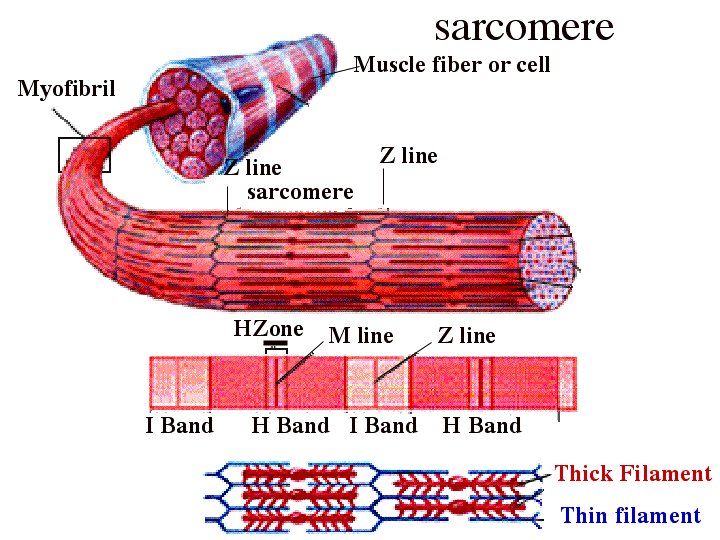 To strengthen a muscle, you have to put enough force on the muscle to damage the Z-lines, as evidenced by bleeding and swelling into the Z-lines. You can tell you have damaged the Z-lines by the feeling of muscle soreness that begins 8 to 24 hours after you have lifted weights or done any form of resistance exercise. That is the time it takes for the swelling to occur in the Z-lines. This is called Delayed Onset Muscle Soreness (DOMS). Exercising your muscles intensely enough to damage them makes muscles stronger so they can withstand higher loads and be more resistant to injury.
When a muscle is damaged, your immune system sends to the damaged tissue large amounts of the same cells (lymphocytes) and chemicals (cytokines) that are used to kill germs when you have an infection. This causes inflammation, characterized by soreness (pain), increased blood flow to the injured fibers (redness), and increased flow of fluid into the damaged area (swelling). The immune cells release tissue growth factors to heal the damaged muscle fibers, and you should allow the muscle soreness to decrease or disappear before exercising intensely again. If you do not wait until the soreness goes away before exercising intensely again, the fibers can be torn, the muscles weaken and you can become injured.
How to Start Your Resistance Training Program
If you are not already doing strength training, check with your doctor to make sure you do not have any condition that may be harmed by exercise. Then read my article on Resistance Exercise You Can Do at Home, or — after you get vaccinated and your community is returning to normal — find a gym that practices sanitizing of equipment, social distancing, wearing masks and good air circulation. On each exercise, pick the resistance that you can comfortably move 10 times in a row, without straining or hurting your muscles. End the workout immediately if you feel pain that does not go away as soon as you stop the movement.
If your muscles still feel sore 48 hours after your first workout, wait until the soreness is gone before you try again. As you become stronger and the resistance feels very easy for you, try to lift 15 times in a row, then perhaps 20 times. Only when you can lift that weight at least 20 times in a row, and not feel sore the next morning, should you try to increase the resistance level.
The key to this program is to avoid injuring your muscles by increasing the number of repetitions gradually so that you do not cause muscle soreness that lasts longer than a day. You should not increase the weight (resistance) until you can lift a set of at least 20 repetitions in each exercise without feeling sore the next morning.
My Recommendations
• Before you start any new exercise program, check with your doctor to rule out any conditions that might be aggravated by resistance training.
• This program is designed for beginners and is intended to prevent injuries that plague older people when they first try to lift weights. It will not build very large muscles, but it will increase your strength and provide all of the other benefits of a weight training program. After many months (injury-free) on this program, if you wish to build larger muscles, you can transition to a more traditional weight training program; see Strength Training Guidelines. Otherwise, you can continue with this safe and effective program of resistance exercise for the rest of your life.
Checked 5/1/23